
History
The first parishioners of St. Boniface were German families who came to Elmont (then Foster's Meadow) in 1840. The families were seeking farmland to replace the farms they had sold in the Middle Village area of Queens as New York City spread eastward.
For 12 years, they traveled back to their home churches for Mass on Sundays and Holy Days. To avoid this arduous weekly journey, the Saint Lawrence Oratory was established in the parlor of a farmhouse owned by Joseph Hermann, near the site of the present church.
Two years later, a small church named the Church of the Nativity of Our Lord was built nearby. In 1857, the name of the church was changed to St. Boniface.
The oratory and the church were mission stations. Priests from parishes in Queens would come on weekends to celebrate Mass and administer the sacraments.
The first of these 'missionary' priests was Rev. George Roesch (1852-1855). The last was Rev. Wilibald Oberschneider (1866-1868). Six other priests served in this manner.
One of them, Rev. Joseph Hauber (1868-1905), established St. Boniface School in the basement of the church in 1857. It was the first parochial school in what is now Nassau County. For 23 years, Dr. Friedrich Wilhelm Germs, a physician, was the only teacher. When Dr. Germs was needed on a sick call, the pastor would take his class.
The Rev. Peter Hartraub was appointed the first resident pastor in 1858. However, during the Civil War, 1861-1865, St. Boniface reverted to mission status and was served again by missionary pastors until 1868.
Fr. Hauber, a recently ordained German immigrant, built a new church where the present church now stands. This was expanded to accommodate 500 in 1889. He also built a new rectory and, in 1887 a new school with four classrooms on the first floor and an auditorium on the second.
He invited The Dominican Sisters to teach in the school and they built a convent on parish land he donated to them. Fr. Hauber was essentially the founding pastor. The buildings he built served the parish well until the mid 20th century. Other pastors until 1948 presided over slow but consistent growth of a parish that retained its rural character until the early 1940s.
Into the early 20th century, there was a shed on the church grounds with stalls for parking horses and carriages during Mass. School opened in October and closed in March to accommodate planting and harvesting. It was not unusual to have Masses offered to request rain.
Fr. John Rath (1931-1948), a native son of St. Boniface, instituted a free bus service from most parish areas to stimulate attendance at Sunday Mass. Soon six Sunday Masses were scheduled and an assistant pastor, Fr. Alfred Blaeser, was assigned.
When Fr. Hack arrived (1948-1972), the parish and community were experiencing a profound change. The German farms were replaced by vast real estate tracts populated by World War II veterans and their families, mostly Catholic.
Between 1950 and 1968, Msgr. Hack replaced every 19th century wooden structure with the parish plant we see today. The new school, opened for the 1951 school year, was doubled in size in 1956 to 16 classrooms, a large auditorium and a gymnasium. a new convent opened in 1965 to accommodate more Dominican Sisters.
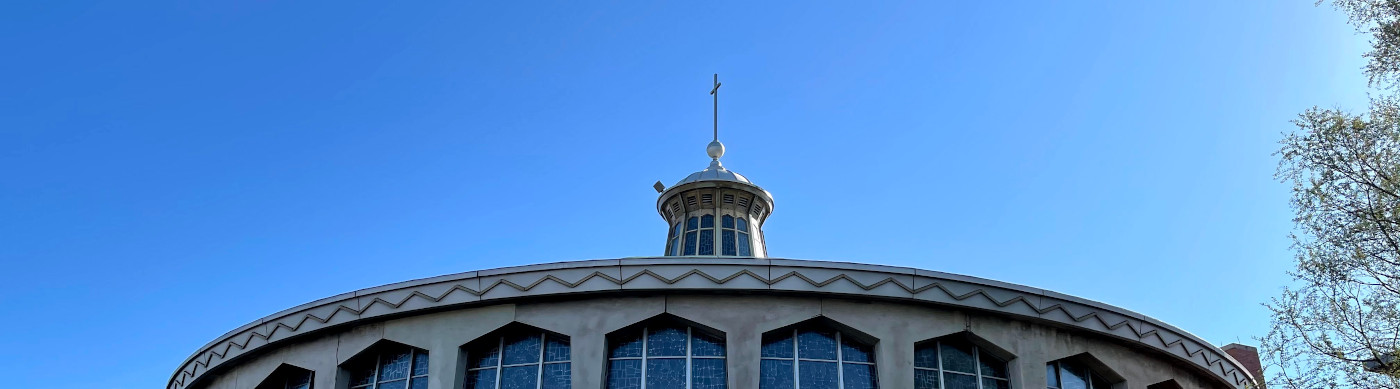
A new church inspired by the Vatican Pavillion Chapel of the Worlds Fair was dedicated in 1968.
Pastors following Hack were concerned with implementing the changes in worship and practice called for by Vatican Council II. The World War II families who had energized the liturgical and social life of the parish were no longer the dominant element of the community.
The 1980 census showed 19 different ethnic and cultural groups substantially represented in the parish, and most of them were Catholic. Father Ryan (1980-1991) often noted that one of the joys of his priesthood was Communion at St. Boniface when the Church universal (almost literally) marched up the center aisle to receive the Eucharist.
St. Boniface School expanded in the mid sixties to a large complex accommodating 1,200 students. This was made possible by the dedication of the Dominican Sisters. The 'band of four' who arrived by carriage in 1886 were followed by more than 100 Sisters who educated thousands of our children over the years.
The last Dominican principal, Sr. Mary Brown, O.P. retired in 1997 ending 111 years of Dominican leadership. Some Dominican Sisters still reside in the convent and one, Sr. Irene Weiner, O.P. teaches first grade in the school.
Enrollment has declined and there were 255 students in the school last year, with 19 teachers and five teachers' aides led by principal Annette Valerio.
The Religious Education program, directed by Sister Peg Fanning, C.S.J., welcomed 650 students last year. Enrollment in both St. Boniface School and the Religious Education program reflect the ethnic composition of the parish.
